

How AI Is Changing Management Careers: What PGDM Students Need to Learn Today
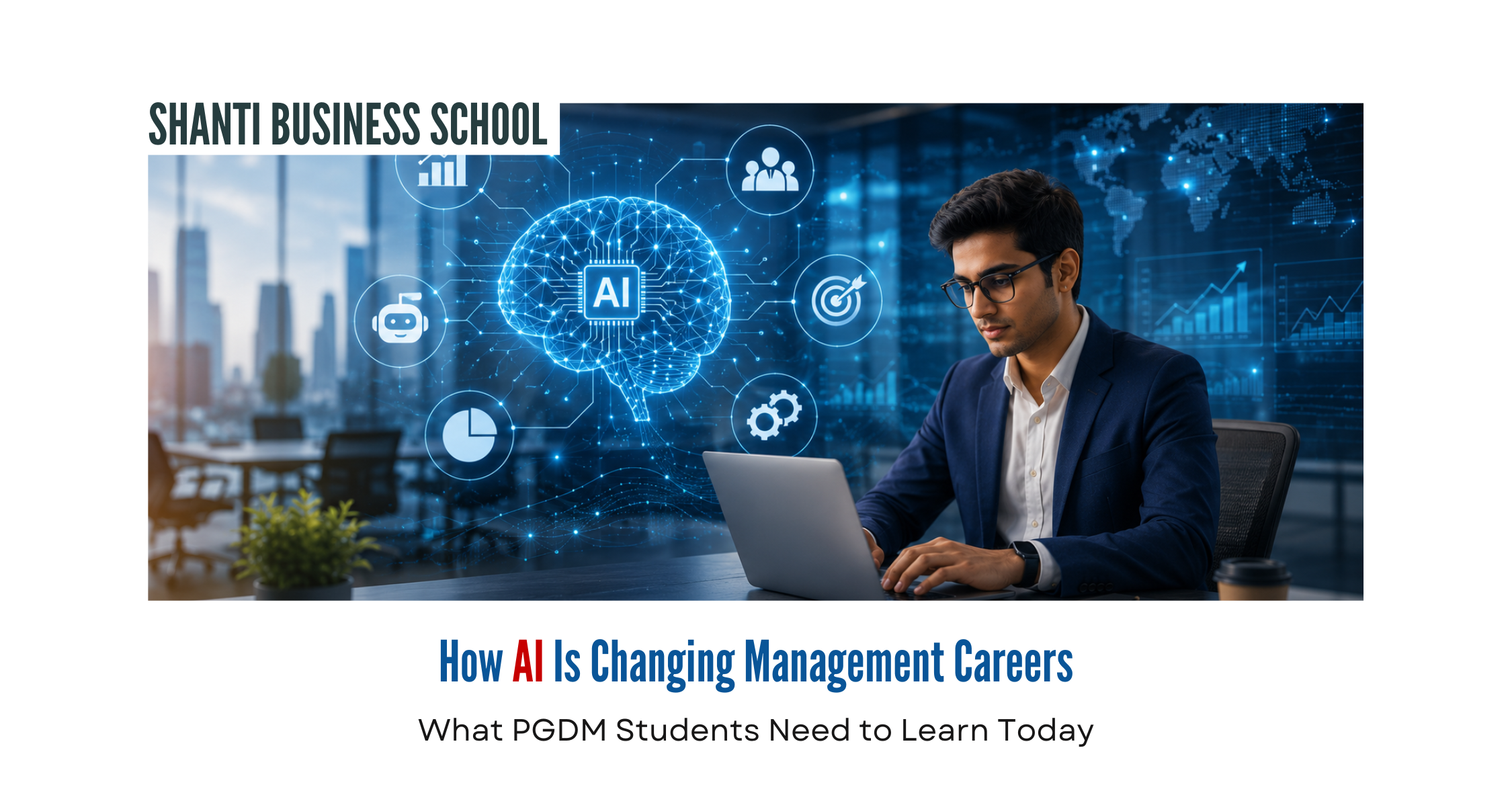
Artificial Intelligence (AI) is no longer a concept reserved for technology companies or research labs. It has become an integral part of how businesses operate, make decisions, engage customers, and drive innovation. From personalised marketing campaigns to financial forecasting and supply chain optimisation, AI is transforming every aspect of the corporate world.
As a result, management careers are evolving rapidly. Employers today are not just looking for graduates with management knowledge—they are seeking professionals who understand how to leverage AI to solve business problems and create value. For PGDM students, developing AI awareness and digital skills has become essential for staying competitive in the modern workplace.
AI Is Redefining the Role of Managers
Traditionally, managers relied on experience and intuition to make decisions. Today, AI-powered tools provide real-time insights, predictive analytics, and data-driven recommendations that help organisations make smarter and faster decisions.
This shift does not reduce the importance of managers—it enhances their role. Modern managers are expected to interpret AI-generated insights, evaluate strategic options, and make informed decisions that align with business objectives.
The future belongs to professionals who can combine human judgment with technological intelligence.
Marketing Is Becoming More Intelligent
Artificial Intelligence has revolutionised marketing by enabling businesses to understand customer preferences like never before. AI tools can analyse consumer behaviour, predict buying patterns, automate campaigns, and personalise communication across digital platforms.
For PGDM students specialising in Marketing, learning about digital marketing analytics, customer relationship management (CRM), and AI-driven campaign optimisation can provide a significant career advantage.
The marketers of tomorrow will not only create creative campaigns but also use AI to measure performance and improve customer engagement.
Finance Is Embracing Automation and Predictive Analytics
The finance industry is experiencing a major transformation through AI and automation. Banks and financial institutions use intelligent systems to detect fraud, assess credit risks, automate transactions, and forecast market trends.
Management graduates pursuing Finance should understand how AI supports financial decision-making and risk analysis. Familiarity with fintech innovations and analytical tools can enhance career prospects in banking, investment management, and financial consulting.
The future finance professional will combine financial expertise with technological understanding.
Human Resources Is Becoming Data-Driven
Artificial Intelligence is also reshaping Human Resources by improving recruitment, employee engagement, and workforce planning.
AI-powered platforms can screen resumes, identify suitable candidates, analyse employee performance, and predict attrition trends. However, while technology streamlines processes, human judgment remains essential in leadership development, culture building, and employee relationships.
PGDM students interested in HR should focus on developing emotional intelligence alongside digital literacy to become effective people leaders in an AI-driven workplace.
Business Analytics: The Bridge Between AI and Business Strategy
Among all management specialisations, Business Analytics has become one of the most closely connected with AI. Organisations depend on analysts to interpret complex data and convert it into strategic business decisions.
Students who develop skills in data visualisation, statistical analysis, business intelligence tools, and AI-assisted decision-making will be well-positioned for high-growth careers across consulting, healthcare, finance, retail, and technology sectors.
The ability to transform data into business value is becoming one of the most sought-after competencies in management.
What PGDM Students Should Learn Today
Success in the age of AI requires more than technical knowledge. Students should develop a combination of business understanding, digital awareness, and problem-solving ability.
Learning tools such as Excel, Power BI, SQL, and basic AI applications can strengthen analytical capabilities. At the same time, communication, leadership, creativity, and strategic thinking remain irreplaceable human skills that technology cannot replicate.
Participating in internships, live projects, certifications, and industry workshops can further help students understand how AI is being applied in real business environments.
AI Will Create More Opportunities Than It Replaces
One of the biggest misconceptions is that AI will eliminate management jobs. In reality, AI is changing the nature of work rather than removing the need for managers.
Routine tasks are increasingly automated, allowing professionals to focus on innovation, strategy, customer relationships, and leadership. Organisations will continue to need managers who can interpret data, lead teams, and make ethical business decisions.
Students who embrace AI as a tool rather than a threat will be better prepared for the careers of tomorrow.
The future of management belongs to professionals who can adapt to technological change while leading with strategic vision and human insight. Shanti Business School prepares students for this evolving landscape through industry-oriented PGDM programs that integrate technology, analytics, innovation, and practical business learning. With a strong focus on experiential education, corporate exposure, and future-ready skill development, SBS empowers students to confidently navigate the AI-driven business world and build successful careers across industries.